Philosopher Profile
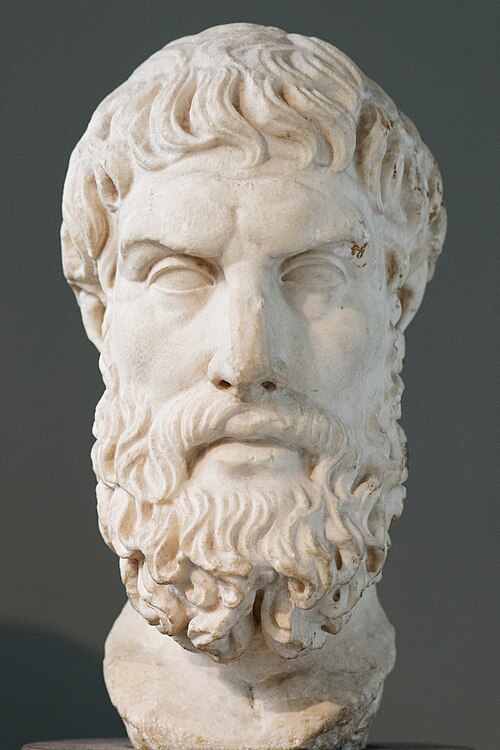
Epicurus Personality Type — The Garden Keeper
Enough is enough. Friendship, simplicity, freedom from fear.
Epicurus (341-270 BCE) taught in a garden outside Athens and told his students the good life was neither heroic nor tortured — it was quiet. Get your fear of death handled, keep a few real friends, want less than you already have, and you have solved the problem that most people spend a lifetime failing to solve. In The Philosopher Test, a very high Serenity score is the fingerprint of that solved life.
Their view of life
"Happiness is not intensity, it is absence of torment. Good friends, simple pleasures, freedom from fear — everything else is noise sold to you as necessity."
Movement
Epicureanism.
How they moved through the world
While others sprint on treadmills of ambition, you've quietly stepped off. Your life is curated, not accumulated. People call it modest; you call it solved.
Legacy and why it still matters
The modern word 'epicurean' has drifted a long way from what Epicurus actually taught. He was not a hedonist; he was a minimalist. His prescription was almost the opposite of the bacchanal his name now evokes: limit your desires, avoid political ambition, keep small circles of loyal friends, and organise your life to eliminate anxiety rather than to maximise pleasure. Most religions and most self-help books have been rediscovering pieces of Epicurus for the last two thousand years without giving him the credit. If Epicurus is your match on The Philosopher Test, you have already solved something most of the ambitious world has not: you know the specific number of friends, meals, hours of sleep and dollars per month at which your life becomes unimprovable. Everything above that number is decoration and everything below it is a problem. Living from that number, in a culture that keeps trying to sell you a bigger one, is the quiet radical act his garden was built to protect.
Their trait fingerprint
In the six-trait model that powers The Philosopher Test, Epicurus's signature is a precise fingerprint. Discipline sits at 45, Curiosity at 65, Resilience at 42, Empathy at 80, Ambition at 15, and Serenity at 92. Read that vector out loud and you can hear the person: the traits that spike are the ones history remembers them for, and the traits that dip are the ones their critics use against them. The quiz computes the cosine similarity between your six numbers and theirs — if the angle between the two vectors is small, you get flagged as a Epicurus match. It's not personality profiling in the clinical sense; it's a mathematical way of asking whether you and this historical mind bend the same way under the same pressures.
Three defining strengths
- Contentment (you know when enough is enough — rarest skill there is)
- Warmth (people relax around you)
- Clarity about what matters (you don't chase prizes you don't actually want)
Signs you think like Epicurus
- You know how to stop wanting things once you have what you need.
- You quietly declined the treadmill of promotions, status upgrades and shopping loops.
- Your happiness looks modest from the outside and feels unshakeable from the inside.
- You choose people you can be silent with over people you have to perform for.
- You've decided fear of missing out is a marketing strategy, not a life plan.
Three quotes to know
Not what we have but what we enjoy constitutes our abundance.
He who is not satisfied with a little, is satisfied with nothing.
It is impossible to live a pleasant life without living wisely, well and justly.
Where to start reading
If Epicurus's mind resonates with yours, these five books are the shortest path in. Books links are Amazon affiliate links.
- “Letters and Sayings of Epicurus” (Epicurus)
- “On the Nature of Things” (Lucretius)
- “The Art of Happiness” (Epicurus, Penguin)
- “How to Be an Epicurean” (Catherine Wilson)
- “The Swerve” (Stephen Greenblatt)
As an Amazon Associate, we earn from qualifying purchases. Book links on this page are affiliate links.
Opposite minds
If Epicurus is one pole of your character sheet, the mirror poles are worth reading against:
Take the test
Are you actually Epicurus? The Philosopher Test — 20 questions, 3 minutes — will tell you where your six traits place you among the eight great minds, including Epicurus (The Garden Keeper) at 45% Discipline / 92% Serenity.
The result is a full character sheet across all six traits, a percentage match, a ranking of all eight philosophers by cosine similarity to your vector, and a shareable image card — all free. If Epicurus is your top match, you'll get a private link to a longer AI-written report for a small fee, but you never have to pay to see who you are. Most people take the test expecting a novelty and stay for the diagnosis: the specific mind in history whose reflexes look most like their own, and the reading path that mind left behind for exactly this moment.
Portrait: Unknown Greek sculptor, via Wikimedia Commons, Public domain.